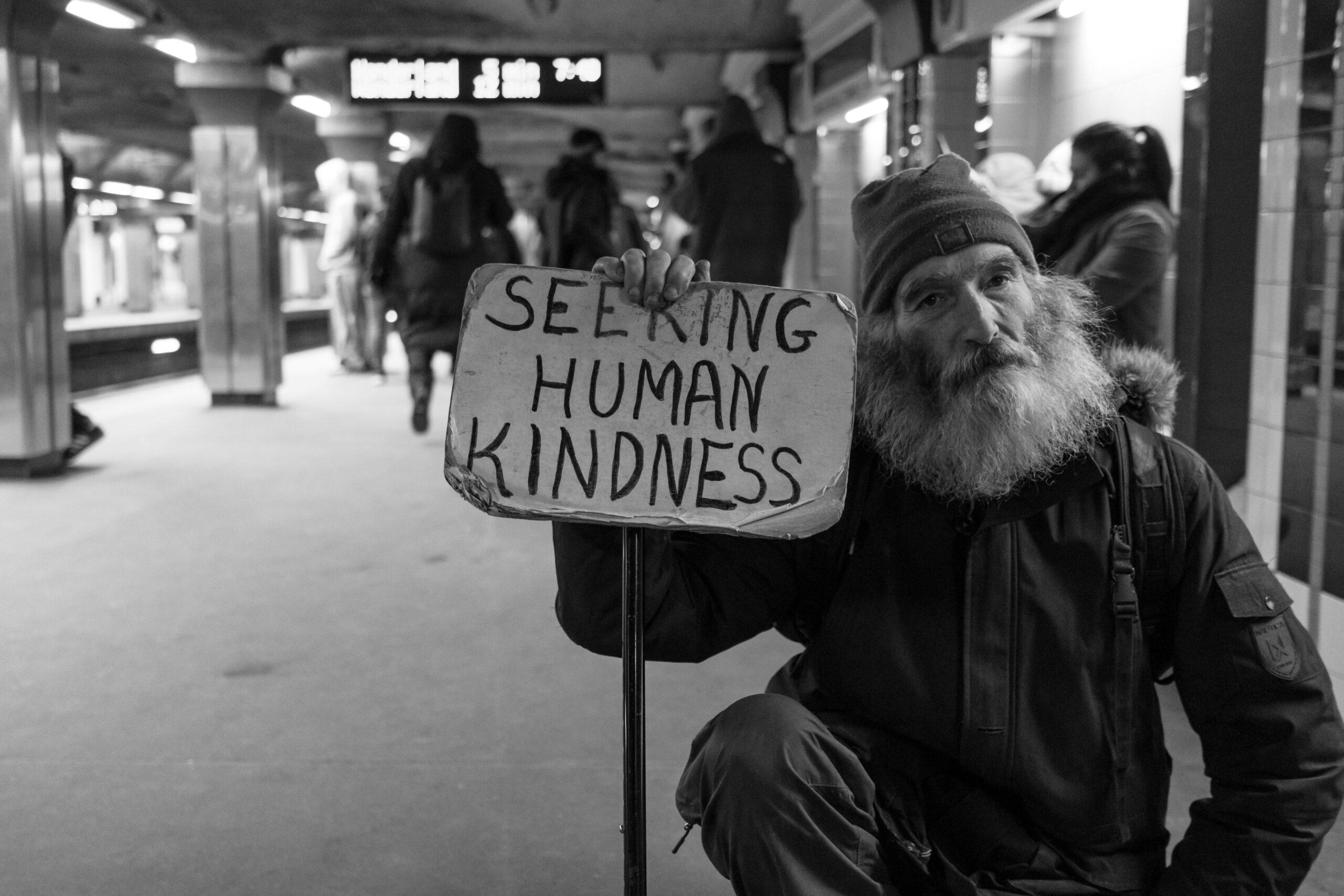
There is a voice missing, one that is multi-lingual; its singing never rising from one throat, always ringing beyond individual vocal chords, identities, characteristics, or features, that echoes throughout the land a strangely controversial idea: The true measure of a human being’s dignity has nothing do with the flags they carry, the soil under their feet, the foods they eat, the color of their faces, which may be female, male, or other, or the funds they have… or have not.
We need a voice that celebrates this “controversial idea” that we all have the same intrinsic worth because each of us is endowed with the breath of the Divine, no matter what, whether we believe in the Divine or not. The mutual flourishing of our lives should not be limited by our fears of scarcity or our need for security. There’s an abundance of kindness that protects each life as precious.
We need to honor the universal kinship of our souls with a way forward. How do we care for one another beyond differences? As we find our way, we need to hear a new voice, rooted in our diversity, intersectionality, and beauty, planted deep in the ancient belief that we are one family, yet sings with confidence that it will be our differences not our similarities that will forge our way into a hopeful future.
How can “otherness” be the path for hope?
As an Episcopal priest and preacher and story-teller, I rely on scripture as one way to claim our inherent dignity. After 9/11, I began to read the Qur’an, at first as a way to confront my ignorance, and then out of curiosity because I discovered so many similar stories about our shared Prophets, and then as a way to strengthen my Christian commitment. As I embraced the verses of the Qur’an as holy, yet very different from my own, I discovered a universal message grounded in the pluralistic monotheism of Judaism, Christianity and Islam:
We all belong to one human family, each one of us a beautiful universe, without any inherent superiority or power to shame. The Sustainer of All Life has endowed each of us with the desire to connect, with the capacity to choose life, and with the hope to make a difference, especially as we care within the depth of love. Ways we abide with each other matters.
Yet, even more was revealed to me. As I crossed the boundary to read scripture, not my own, I experienced the overarching profundity of the Divine’s reach for all. And I became increasingly aware of Holy Texts that could be claimed beyond the scripture of the monotheistic religions.
These Holy Texts came in many forms, and not just as religious. They came as poetry, as novels, as the land. These texts became holy for me when they shined a light on the beauty of my own dignity, as well as others, to uphold the flourishing of all life. There are so many examples:
The Big Book referenced in AA meetings has saved many a life. Many memorize Mary Oliver poems as they do psalms as a way to transcend suffering. My own daughters who grew up reading the Harry Potter series can easily defend the religious idea that death never has the last word. As I listened to the conversations they had with their friends about loyalty, love, risk-taking, and defending the good, I recognized them as holy exchanges, passionate and critical to developing their own voices of integrity.
Many as well “read” books that have no written text, like the Book of Nature or the Book of Self or the Book of Art as a way to find purpose, as a way to provide clean water, adequate food, safe housing and meaningful work for too many who live under fear and oppression
These Holy Texts, however they may be claimed, are holy when they shine a light on the force of love’s bonding. Love, never ending, is beyond sentimental feelings. Love is the way we name that which moves us to a greater complexity, while also creating a unification of coherence and order.
In other words, Love is the energy attracting all things to one another, like gravity, electromagnetic fields, ecosystems, evolution, sexual attraction, instinct, a mother’s or father’s protection, abiding friendship… As we claim Love’s bond with all, we are moving beyond our own religious and philosophical and secular traditions into a pluralistic humanism. With one voice trained by “otherness,” we claim each other’s dignity.
Together, let’s read our Holy Texts as a way to bond.
Many fellow religionists may disagree with the inclusivity that I am claiming, even though it is a religious idea that has been expressed throughout the centuries. We are human and holy because the Gift of God’s Continual Presence, the Spark of the Divine, resides in all of us, woven in the very fabric of our being, and has never relied on whether we believe in that Presence or not. Never demanding, the invitation is to embrace the gift. It comes to us in many ways, revealed through different acts of yielding, through yearning, giving, and trusting, and by committing to live no longer tied to a small self that reflects arrogance, fear, and hypocrisy.
In these troubling times, when we are divided by so much fear and violence, those who are religious need to liberate stories about the Giver of Life away from condemnation, “should(s) and have-to(s),” exclusion, and fear. Too often, religious people leave proclamations about God to throats that are like open graves (sometimes our own), convincing all that our failures and limitations are the best “tell” of who we really are. These throats, closing in like sandstone tombs, bury us alive with shovels of shame, regret, suffering, and misery (See Psalm 5:9).
Rather, we need to proclaim that the Divine resides in all human-stories, wherever they may be, for a simple reason. How else are we to come to know the Living Spirit of All Life? Our individual, unique, stories matter as they reveal to us the profundity of our lives: what’s real and messy, what wavers, what’s good and bad.
Embracing the Living Spirit of All Life helps us to recognize love and grace through tears and laughter and gives us courage to endure suffering, to find forgiveness, and to express beauty. We are guided to live in tenderness, even within brokenness. We recognize we are more than “the something” that “things” happen to.
By hearing a new voice, we understand our fully holy, fully human lives in new ways. To be able to listen carefully, we need to take risks by leaving our places of security, however we define them: in our accomplishments, our set answers, our creeds, our borders, our denials, our ego strengths, our good luck, and our status.
Leave them behind; walk away from the Garden of Eden, or however your images of perfection are imagined, and move to the garden’s edge, where you are undefended, curious, capable of surprise, and open to the present moment, where the poverty of your small self is clear.
Enter a new place, thinly designed, between heaven and earth, with no handle for you to hold onto. On that threshold there is a path inviting you to travel in search of knowledge and wisdom, with a deep desire to seek what is true, revealed through a diversity of word and deed that comes to us in so many unique and gifted ways.
Sojourners live on that threshold, not just the edge, but the ledge of the edge, which is why they need to be protected and blessed. Embracing the diversity of “otherness” is not for the weary. Crossing boundaries involves tests and trials and tribulations, maybe even terror, yet at every boundary, there is a new vista.
During these troubling times, may we trust in our sojourners, and possibly risk becoming one ourselves as we seek to live into this new vista. A vista that invites us to kneel to the ground of each other’s being, so we can hear the voice, the voice that needs every breath as we discover ways to defend and honor each other’s dignity.
Our very lives, even the planet’s existence, may depend on our courage to hear the voice that has been missing.