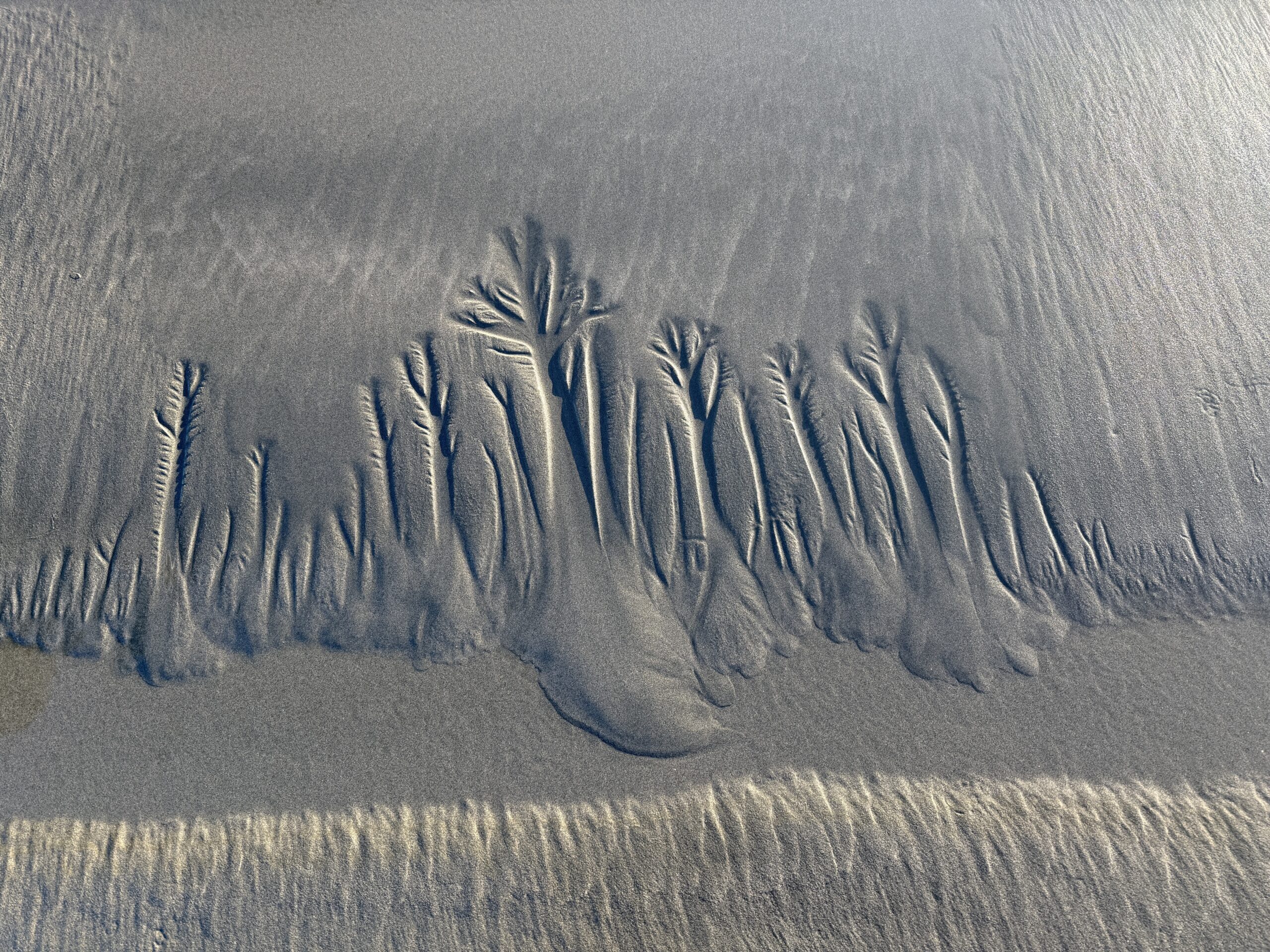
Which, then, is the better: he who has founded his building on God-consciousness and a desire for His goodly acceptance – or he who has founded his building on the edge of a water-worn, crumbling river-bank, so that it is bound to tumble down? Surah 9:110
So many of Prophet Muhammad’s detractors challenged him to give proof that he was a prophet. Who was he, a mere mortal man, to be their leader and their guide, as someone who was breaking ground in a new way of seeing? Like Jesus, he was admonishing his people to build their houses on rock, so even if the rains fell, floods came, and winds blew and beat, their homes would not fall, unlike the foolish who built their houses on sand (See Gospel of Matthew 7:21-28).
Prophet Muhammad, secure in self-surrender as his religion, where all find peace and wholeness, did not acknowledge his critics’ mocking ridicule, nor did he taunt them about their ignorance. He knew their false imageries would forsake them. He continued to point to the idea of the world, beyond himself.
Fortified by the revealed verses of the Qur’an, Prophet Muhammad continued to urge his detractors to ponder on their own birth. Stop! Take a moment; don’t take everything for granted. Will you look upon the world and contemplate its origins? All creatures in the Heavens and on Earth praise God’s limitless glory. Why even the birds as they outspread their wings are in prayer (See Surah 24:41).
In the midst of one of the greatest challenges to the Prophet’s authority, he did not become defensive, angry or sullen. Mirroring the Qur’an’s revelation about the gift and the power of creation, Prophet Muhammad turned to creation as proof.
~ ~ ~ ~
In 1983, during my second year of divinity school at Union Theological Seminary in New York City, I read the news that a geneticist, Dr. Barbara McClintock, won the Nobel Prize for her discovery that beyond mutations, genes could “jump” under the control of the organism. She created the first genetic map of a chromosome for corn and from that theorized genetic transference. Something that other scientists could only demonstrate much later using computer modeling.
I didn’t understand much of the science, but as a woman, I was drawn to Dr. McClintock’s courage. Even though she was respected, she was called “a loner, difficult, prickly.” Her earlier findings, though accurate, did not fit in the standard frame of analysis, as she challenged the neo-Darwinian theory that when genetic variation occurs it is always random, never under the control of the organism. The science was saying this was not true.
Throughout her career, she focused on seeing in a new way, an “inner vision.” For her, Nature was a Book to be read simultaneously by the eyes of the body and the mind. One of her colleagues asked her how she saw “so much” when she looked at a cell under a microscope. She answered, “Well, you know, when I look at a cell, I get down in that cell and look around.”
She never paid attention to her critics, by claiming, “If you know you are on the right track, if you have this inner knowledge, then nobody can turn you off… no matter what they say.”
As a researcher, where for 50 years, much to the chagrin and ridicule of her colleagues, she planted corn in her lab and in fields which was cheap, plentiful, and easy to grow. She spent an “enormous amount of hours paying attention to the corn,” so much so that “I had a hard time leaving the corn, so attached I was…I don’t feel I really know the story if I don’t watch the plant all the way along.” She believed she was in a “place where the mysteries lie,” listening to what the corn needed to tell her, “allowing it to teach me its secrets.”
As a scientist, and eventually a Nobel Prize winner, speaking and thinking in these ways led to her discovery of the ability of genes to change positions on chromosomes. When interviewed later, Dr. McClintock tried to explain her deep relationship with corn. “You somehow have to have a feeling for the organism.”
She had “an exceedingly strong feeling” for the oneness of things. “What we do is make these subdivisions, but they’re not real. Basically, everything is one.”
When pushed to explain further, and at a loss of words, she said, “Really, all I can tell you about doing great science is that you somehow have to learn…to lean into the kernel.” *
*These quotes of Dr. McClintock come from interviews with Evelyn Fox Keller, A Feeling for the Organism, the Life and Work of Barbara McClintock (New York: W.H. Freeman and Company, 1983), pp. 197-207.
Day 11: Reflection
I believe we all need help in trusting to lean into each other, to be in deep relationship, to listen to each other’s mysteries as we try to find where they lie, and to believe that these mysteries have something to tell us. Like a miracle, these mysteries do not need to be contained only within the supernatural.
In the building or your life, know that the earth is a resting place for you and the sky a canopy, and you formed so well (See Surah 40:64).
Where are you founding the building of your life?